
Behavioral State Decay is the phenomenon where an AI agent loses track of agreements, fault diagnoses, or prerequisites made during a long-running business process because the context window fills up. This is not solved by larger context windows, but by a proactive memory agent that injects active reminders at the right moments. Without this active memory, agents repeat mistakes, reducing task success rates by over 8% and causing unnecessary token costs.
The Problem: Why Larger Context Windows Don't Help
There's a persistent misconception that memory problems in AI agents disappear once language models can process millions of tokens of context. In practice, the opposite is true.
When an agent executes dozens of steps in sequence (such as verifying client files, consulting a CRM, and preparing documents), essential information gets buried under a mountain of intermediate steps, logs, and API responses.
Researchers call this failure behavioral state decay. The agent knows the rule somewhere in its history, but the information gets so far from the current decision point that the model ignores it. The result? The agent makes the exact same mistake in step 15 that was already discovered and corrected in step 3.
Passive RAG Falls Short
Many developers try to solve this with traditional RAG (Retrieval-Augmented Generation). An agent searches a database whenever it needs information.
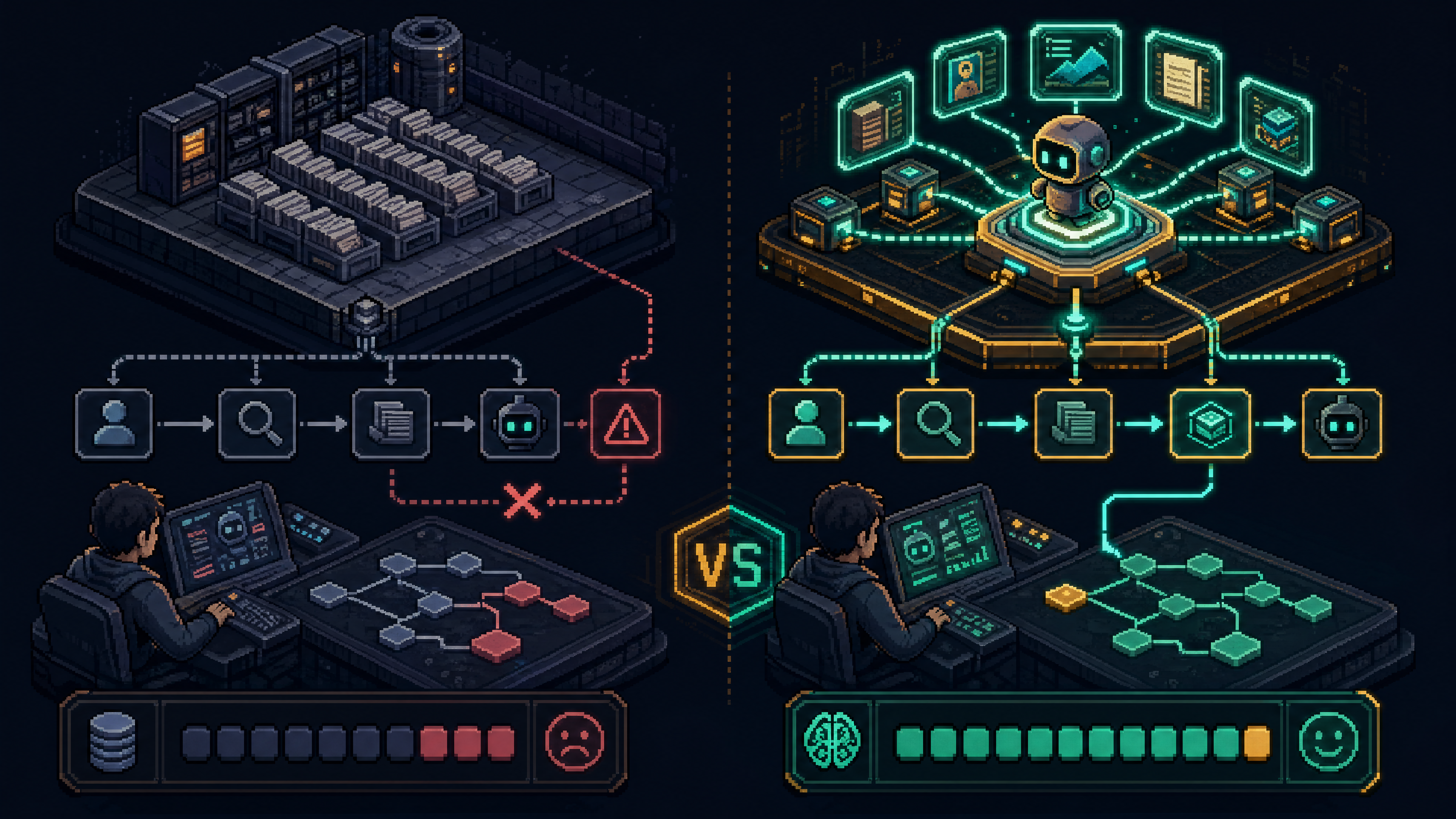
But passive RAG has one major flaw: the agent must realize it needs to look something up. If an agent doesn't realize it's about to violate a prerequisite, it won't send a search query to its memory. Passive storage waits. It doesn't intervene.
The Solution: A Proactive Memory Agent
Newly published research on Hugging Face ("Remember When It Matters", paper 2607.08716) introduces an elegant architecture that applies this same principle we use at UPPR.
Instead of a single agent doing everything, a second, specialized memory agent runs alongside the executing agent.
This memory agent tracks goals, fault diagnoses, and prerequisites in a structured digital brain. At crucial decision points, it analyzes the direction of the executing agent. Is the agent about to forget an agreement? Then the memory agent proactively injects a very short, targeted reminder into the process.
Benchmarks like Terminal-Bench 2.0 show that this proactive intervention improves performance on complex agent tasks by 6.8 to 8.3 percentage points, even with the fastest and smartest frontier models.
What This Means for Your Organization
For companies deploying AI agents on business-critical processes (such as accounting, healthcare administration, or legal intake), reliability is the only metric that matters. An agent that forgets the client's privacy rules after ten minutes of work is unusable on the shop floor.
At UPPR, we build with a 4-layer architecture where the digital brain and soul file (identity and agreements) are separate from the executing engine. The agent doesn't need to reinvent who it is or what the rules are at every step. The structure guards the boundaries.
Sovereign AI is not just about where your data lives, but also about control over the process. An agent with active, proactive memory makes fewer mistakes, consumes fewer tokens, and delivers the reliability you're looking for in automation.