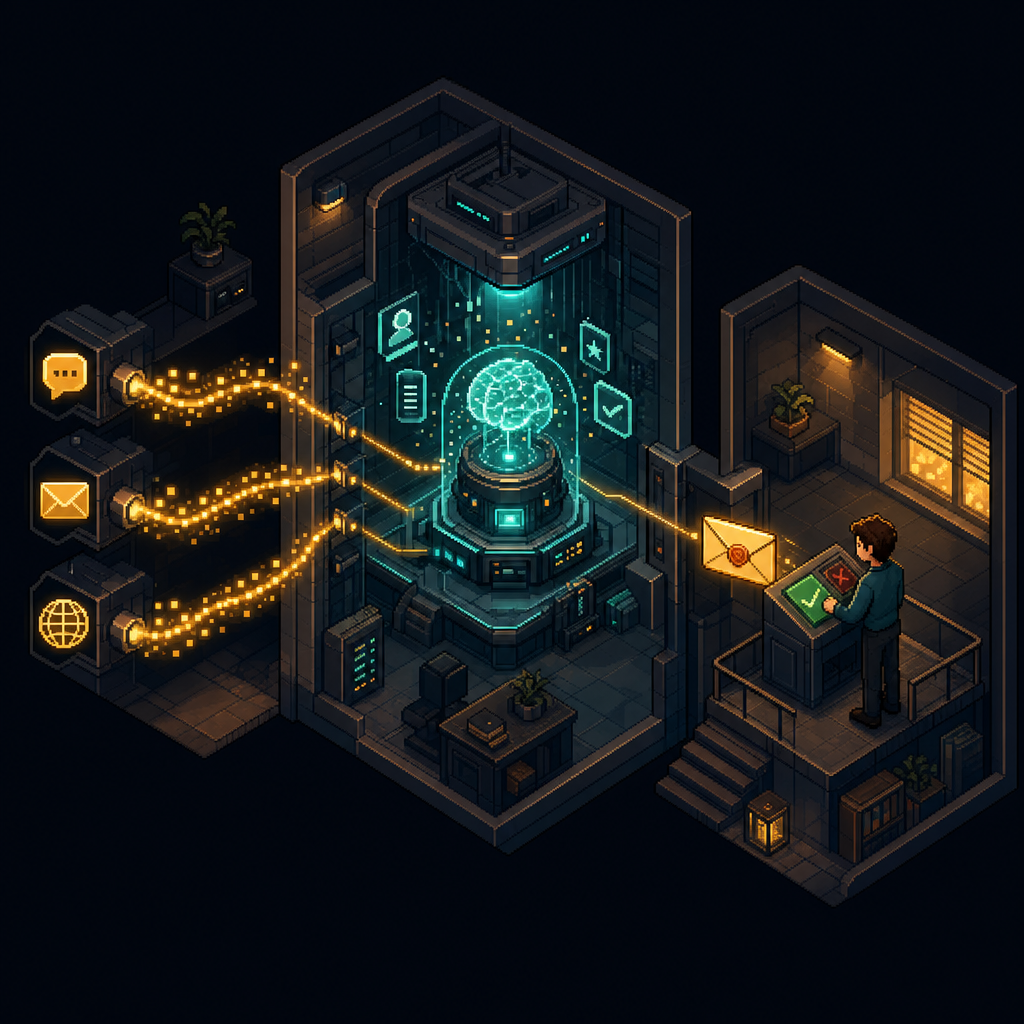
An Agentic OS does the groundwork in your go-to-market: picking up signals, enriching prospects, determining a relevant reason and preparing a message that you approve. The difference from a standalone sequencing tool or an AI SDR: those fire off a fixed sequence. The agent determines the reason itself, works in your CRM with your business knowledge and sends nothing without your approval. The conversation stays yours.
This article walks through how that system works step by step, where the human stays in the process and what it delivered in our own practice. Written for whoever is commercially responsible at a B2B company and wants to put AI to work without losing their grip on their own data. I've included our own numbers and external studies, with sources.
Three places where opportunities slip away
Most B2B companies lose opportunities in three very ordinary places.
The first: a signal comes in and nothing happens. Someone responds to a post or visits your site, but nobody picks it up. The second: context is everywhere and nowhere. Part of it sits in LinkedIn, part in the inbox and the CRM, and the rest in a salesperson's head, who has to go looking for it all over again every time. The third: follow-up runs on luck. Whether someone comes back depends on who remembers, not on an agreement.
An Agentic OS tackles exactly these three.
What an Agentic OS is, in plain words
Agentic OS is another one of those English terms. What it means is simple, so I'll just explain it: a layer on top of your existing systems that executes tasks instead of only giving answers. I've explained before what an AI agent actually is and why it's not a chatbot: https://uppr.online/blog/wat-is-een-ai-agent-en-waarom-is-het-geen-chatbot.
At UPPR, this runs on an open-source agent framework that handles tools, memory and permissions and connects to your own systems via MCP. MCP is an open standard that lets agents call connections to things like your CRM, mailbox and calendar in one uniform way. You don't have to remember those terms, by the way. The point is that the framework handles the technology and you set the rules. How such a system hooks up to your existing systems is covered here: https://uppr.online/blog/hoe-een-agentic-os-je-bestaande-systemen-verbindt.
The memory sits in what we call the Digital Brain: the place where context, contact history and lessons learned from every interaction come together. In three sentences: the model interprets. Hermes, our orchestrator, coordinates. The Digital Brain remembers and learns.
The model is an open-weight model, in the presentation DeepSeek V4.1 Flash, or another open model that fits the hardware and the use case. And that brings us to the second characteristic: the entire stack runs on your own hardware or in your own cloud. The three options we mentioned: an NVIDIA DGX Spark with 128 GB unified memory (models up to 200 billion parameters), an NVIDIA DGX Station with 748 GB coherent memory, or the same stack in your own Azure or Google Vertex AI tenant. Why that matters, I've explained separately here: https://uppr.online/blog/data-sovereignty-waarom-het-uitmaakt-waar-je-ai-draait. In short: your data stays inside your own environment instead of being processed at a vendor.
The route every lead follows
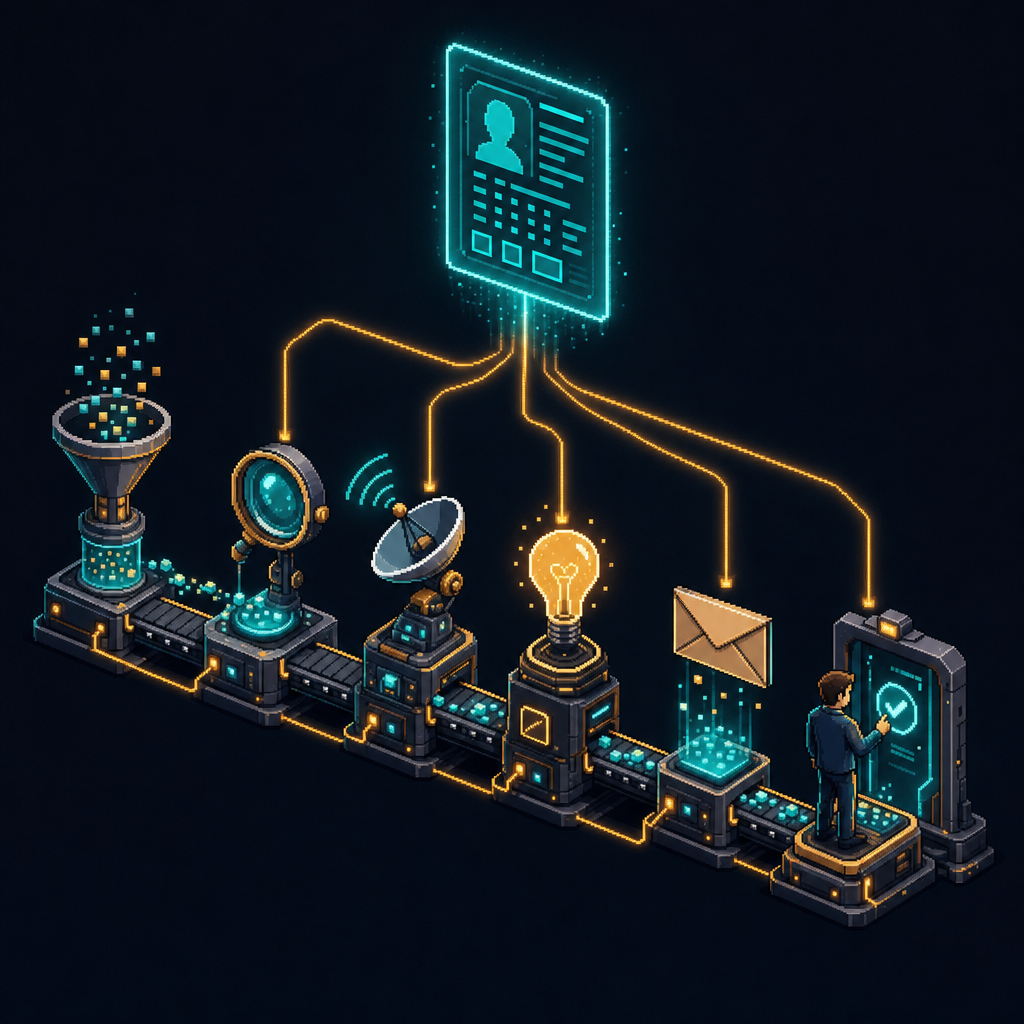
Every lead follows the same route. First an ICP check: does this company fit the ideal customer profile, and might we already know someone there? Then the agent enriches the company and the decision-maker. Next it collects signals: what does the company do, what has changed, where is a reason to reach out now. Based on that, the agent determines a relevant reason and prepares a message or card, a human looks it over and only after approval does it go out the door. Then comes the follow-up.
There are two entry points, inbound and outbound, and one prospect file. The CRM runs along every step: context, contact history, status and the next action are all kept up to date there.
The agent does this work continuously. It observes (LinkedIn, website, news), does research (Apollo, Hunter, company sources), remembers (CRM, contact history, meetings) and executes (email, LinkedIn, calendar). Triggers to act: a scheduled moment, a new prospect, a reply or a reached follow-up date.
And one rule is non-negotiable: without a reason, the agent only keeps an eye on what's happening and sends nothing. One signal is not yet a reason. Together they are.
Where the human stays
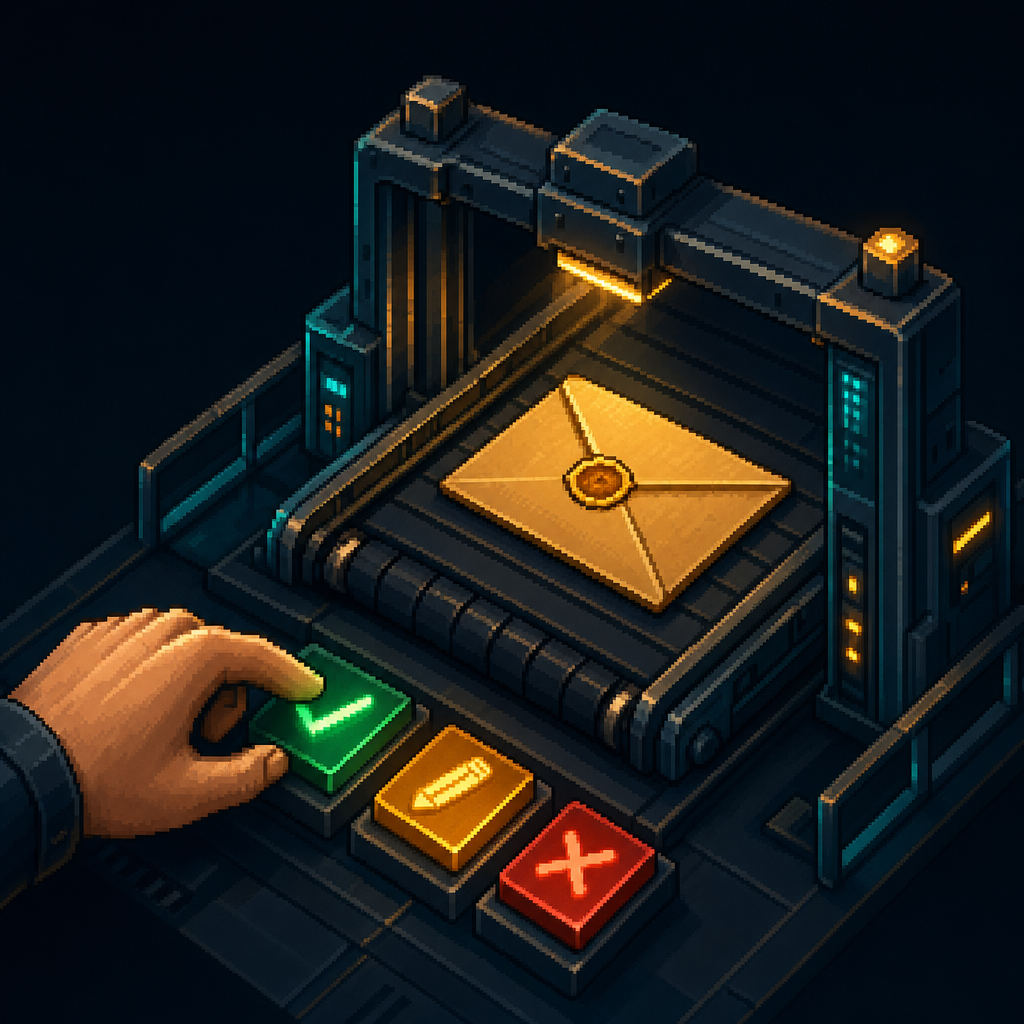
The question I hear most often about this: is there anything left of the salesperson? Yes, and it's the most important part.
The human sets the boundaries. Which signals count, which sources the agent may consult, what the system may do on its own and what not. And nothing goes out without approval: every message, every card and every follow-up is first put in front of a human. The agent prepares, you decide and you have the conversation.
That also applies to processing. At UPPR we implement AI safely, within the company's own environment. Nothing is sent without someone approving it. Processing happens on your own hardware or in your own cloud, and external sources and channels, like LinkedIn and your email provider, keep their own data flows.
An agent takes the groundwork out of your hands. The conversation stays yours.
What happens after a reply
Every reply gets a follow-up, from the existing file. Four situations, four fixed next steps.
- Interested: the agent prepares the meeting, aligns on availability, shares context and updates the CRM status.
- Not now: a follow-up task goes into the file with a reason and a timing, so it no longer runs on luck.
- No reply: then you call. With full context and contact details in the CRM, so without first spending ten minutes working out who this was again.
- Opt-out: the request is logged, open follow-ups are cancelled and this prospect never enters outreach again.
That last one is not a detail. It's exactly the kind of commitment you lose the moment automation sits apart from your CRM.
An example, step by step
To make it concrete, first a made-up example. Say: a commercial director at a mid-sized SaaS vendor responds to a LinkedIn post about pricing. That's signal one. The agent sees it, checks whether the company fits the ICP, enriches the company and the decision-maker and adds more signals, such as a visit to the site, a vacancy for account executives and a message about a funding round.
Based on that combination, the agent determines a reason to reach out now and prepares a message. You approve it, and only then does it go out.
That doesn't have to be an email, by the way. At UPPR we also use a physical card as a first touchpoint: a card written by hand, approved by a human before it goes in the mail. If the recipient makes an effort, a scan or a visit to the personal page for example, that's a new signal and the agent prepares the next fitting follow-up. No scan? Even then, a fitting follow-up remains possible.
What makes this different from a standalone sequencing tool or AI SDR
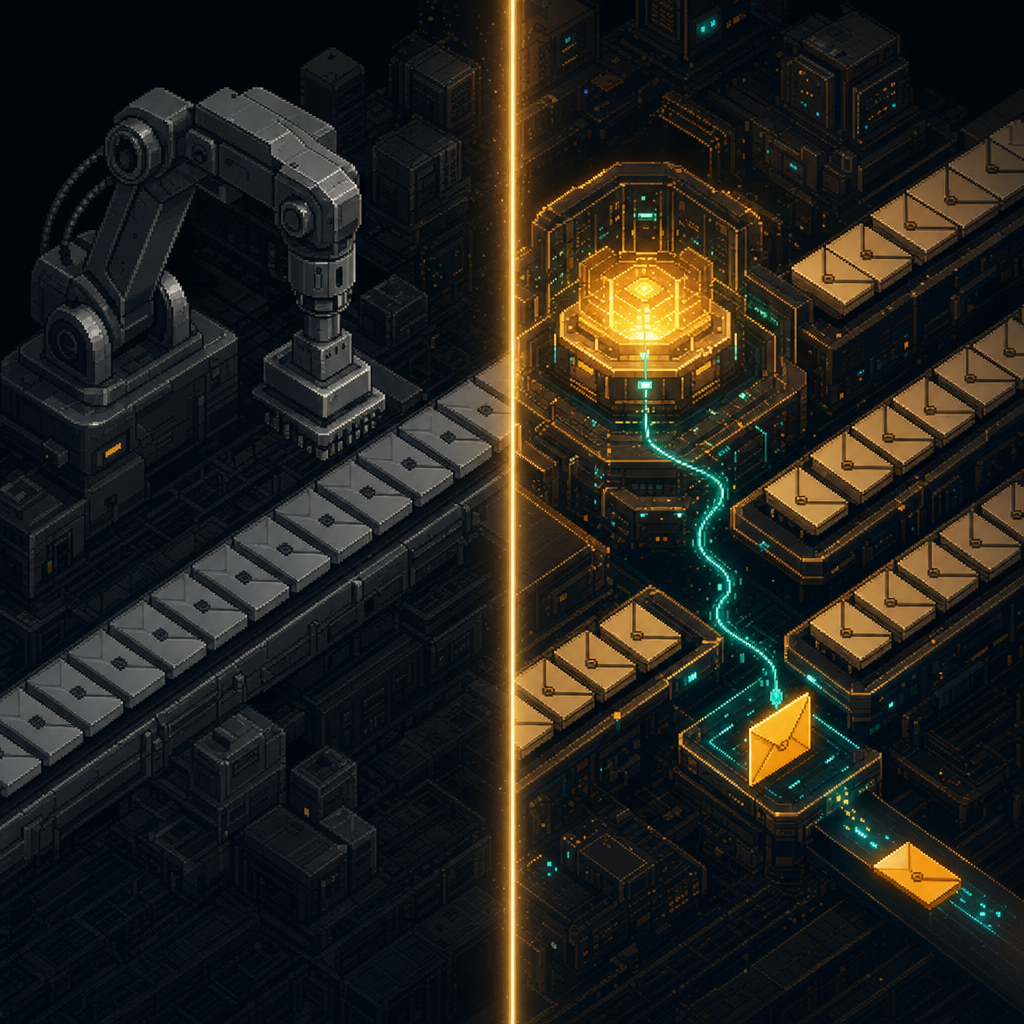
On paper it looks like the same thing: contact goes out automatically. The difference is in five points.
| Standalone sequencing tool or AI SDR | Agentic OS |
|---|---|
| Fires off a fixed sequence | Determines the reason itself and what it sends |
| Lives next to your CRM, with its own data | Works in your CRM, with your business knowledge |
| Processing at the vendor | Processing on your own hardware or in your own cloud, such as Azure or Vertex AI |
| Often fully automated | Nothing goes out without your approval |
| One tool for one purpose | One process: the same foundation also carries finance, recruitment and customer service |
That last point might just be the most important. This is one process. We use the same foundation for finance, recruitment and customer service. You're building an infrastructure that carries multiple processes, instead of a sales tool that gets replaced in three years.
Standalone tools also mean separate subscriptions, by the way. I've explained before why rising AI costs mean the end of separate API subscriptions (https://uppr.online/blog/waarom-stijgende-ai-kosten-het-einde-betekenen-van-losse-api-abonnementen) and how you lower operational costs with an Agentic OS (https://uppr.online/blog/operationele-kosten-verlagen-met-een-agentic-os).
What it delivered in our own practice
This has been running at UPPR itself since July 2026, via LinkedIn and email. The numbers so far: 143 Tier 1 prospects, the group that fits our profile best, found through inbound and outbound, enriched and approached. 38 percent responded. 23 prospects turned out to be interested and every one of them booked a meeting. So far, 19 new customers have come out of that, a conversion of 83 percent. Some sales cycles are still running.
Two caveats, because this is not independent research. It's our own practice on a limited scale, in our market, with our target audience. And the numbers mainly say something about the groundwork: the agent found and prepared everything, the meetings and the conversations were ours. From first signal to new customer: the agent did the groundwork, we had the conversations.
What the market does and says
You don't have to take my word for it. A few recent studies.
RevSure and Ascend2 surveyed 306 senior marketing and RevOps leaders in the US and the UK for The 2026 State of Agentic AI in B2B GTM. 76 percent of B2B organizations are implementing agentic AI or actively rolling it out. 96 percent believe that agents with context across the entire funnel would substantially improve execution. 86 percent expect ROI within twelve months, 40 percent even within six months. Two caveats from the same study: 54 percent name security and privacy concerns as the biggest barrier, and 77 percent fear that agentic AI without alignment becomes a new silo. Source: https://www.revsure.ai/white-papers/the-2026-state-of-agentic-ai-in-b2b-gtm
Deloitte Digital surveyed 530 US B2B sellers and 530 B2B buyers in February 2026. 45 percent of sellers use AI in sales, but only 24 percent use real agentic AI. Buyers are ahead: 61 percent use AI in procurement and 38 percent agentic AI. Digitally mature sellers are five times more likely to use agentic AI and hit their annual growth goals far more often than less mature competitors. About two thirds of sellers without agentic AI plan to start using it. Source: https://www.deloittedigital.com/content/dam/digital/global/documents/insights-20260206-b2b-commerce-research-report.pdf
MIT Technology Review Insights and EnterpriseDB published a survey of more than 2,000 senior executives in 13 countries in May 2026. Organizations deeply committed to controlling their data, infrastructure, models and governance get five times more ROI from generative and agentic AI. 95 percent of organizations plan to have their own AI and data platform within three years. More than half already have autonomous agents in production making decisions on operational data. Source: https://softwarenewswire.com/press-release/sovereignty-is-the-new-operating-system-for-agentic-ai-new-mit-technology-review-insights-report-finds-302771804-192330
And then the counterpoint, because that belongs here too. Gartner predicts that more than 40 percent of agentic AI projects will be cancelled by the end of 2027, due to rising costs, unclear business value and insufficient risk control. A later prediction goes further: 40 percent of enterprises would degrade or shut down autonomous agents in 2027, because governance gaps only become visible after an incident in production. As the cause, Gartner names that companies treat agent governance as binary: either fully locked down, or fully trusted. Source: https://aifounders.cz/en/ai-agents-outran-their-governance-now-gartner-predicts-a-40-pullback
That last prediction captures the dilemma well. Fully locked down means you win nothing, fully trusted means you lose control the moment something goes wrong. The middle way we choose is a system that continuously does the groundwork and where nothing goes out without a human approving it.
Where would you start?
Start with the same question as at the beginning: where are opportunities slipping away for you right now? Three things to check: where do signals sit that nobody picks up, how much time goes into searching for the same context over and over, and where does follow-up depend on who remembers? That's the groundwork an agent picks up continuously, within your rules and with your approval as the last step. What's left for you: the conversations.